


Page 16 - VHSA - Onderstepoort 100 Years - Part 2
P. 16
OND
ERSTEPOORT 100
to study the anatomy of the camel which led to the publication in 1986 of the first comprehensive textbook entitled ‘Anatomy of the Dromedary’, in collaboration with her associate A.J. Bezuidenhout. She was also responsible for the modernization of course material and the development of videos to achieve it. Two of these were awarded by the university as the best educational videos produced in 1989 and 1992 respectively. Bezuidenhout was instrumental in adapting the research programme of the Anatomy Department, of which he became Head in 1986, to the mission of the Faculty which included an emphasis on wildlife diseases. One result of this change was pioneering research on the anatomy of the ostrich, work that is still ongoing.
During the last decade of the 20th
century this process of renewal and curricular transformation continued with a change to a species-based approach and the integration of the anatomy and embryology courses. The amalgamation with Medunsa also presented challenges and required revisions which were led by H.B. (Herman) Groenewald, who succeeded Bezuidenhout
in 1999 as head of the department. The
amalgamation was closely followed by a
rationalization of departments in the new
Faculty in 2001, resulting in the merging of
the Anatomy and Physiology Departments
and the Electron Microscopy Unit.
Medicine
In 1920 P.R. Viljoen was appointed as the first professor and head of the De- partment Materia Medica in the newly founded Faculty, after he had originally been appointed to the chair of Anatomy. In 1923 he was transferred to the Depart- ment of State Veterinary Medicine and was replaced in what then became known as the Department of Veterinary Medicine by C.P. Neser. Neser founded a new department called Pathological Physiology in 1928 and was succeeded by P.J.J. Fourie. Neser died unexpectedly the following year and again Fourie took his place while B.S. Parkin took over Veterinary Medicine. Parkin guided the department with distinction for more than 20 years until his death in 1951. He
was best known for his research on the chemotherapy of trypanosomosis in cattle and biliary fever in dogs. His successor as professor and head of the department was W.D. Malherbe, previously lecturer in the same department.
When the Faculty was reorganized and consolidated in 1957/58 a new Department of Internal Medicine was formed with K. (Keiser) van der Walt as professor and head. It also included Toxicology and Pharmacology as well as the Ambulatory Clinic and Materia Medica. In 1965 the name was changed back to Medicine and in 1972 Pharmacology was transferred to Physiology followed by Toxicology in 1979. Van der Walt was one of the first appointments from the private sector and served for 26 years until his death in 1984. He was a pioneer in the use of chemical immobilization of wildlife and was involved in an advisory capacity in the development of several veterinary drugs. He also served on various occasions as Acting Dean. His successor was P. Bland-van den Berg who was in turn succeeded by S.R. van Amstel after being promoted to the new
Groenewald was subsequently ap- 76 pointed as the head of the new Depart- ment of Anatomy and Physiology with J.G. (Johnny) van der Walt as head of the Physiology Section. In 2004 van der Walt passed away and J.T. (John) Soley was appointed section head of Physiology. In the years following amalgamation the department has expanded its research on wildlife anatomy, with studies being conducted on various aspects of the anatomy of the ostrich, crocodile, African buffalo and elephant. The department has firm research and teaching partnerships with a number of well-known overseas universities including the University of Veterinary Medicine in Vienna; the Faculty of Veterinary Science, Swedish University of Agriculture and the Utrecht University in the Netherlands. There are currently three professors and four associate professors among the lecturing personnel. Eight members of the current staff hold doctoral
degrees.
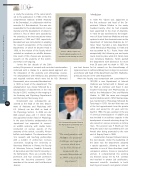
“The amalgamation with Medunsa also presented challenges and required revisions which were
led by H.B. (Herman) Groenewald, who succeeded Bezuidenhout in 1999 as head of the department.”
post of Deputy Dean in 1988. Fundamental changes followed during
the next decade. Under the leadership of the latter two the department adopted a species approach, allowing its staff to specialize in one of three directions: small companion animals, horses or production animals. It complemented the existing pig diseases group led by R.K. Loveday and resulted in greater job satisfaction, improved scientific standards in both teaching and research and greater interest
PART 2
Faculty of Veterinary Science: General History
1908-2008
Years


