


Page 18 - VHSA - Onderstepoort 100 Years - Part 2
P. 18
OND
ERSTEPOORT 100
West University at Potchefstroom. After restructuring of the amalgamated faculty in 2001 Swan became head of the Department of Paraclinical Sciences which included the disciplines pharmacology, toxicology, pathology, veterinary public health and phytomedicine. In
2002 V. (Vinny) Naidoo was appointed to succeed Gehring and to take over the pharmacokinetic research responsibilities. Following the retirement of Catton, J.G. (Jan) Myburgh was appointed in 2003 with the responsibility to focus his attention on the field of environmental health and toxicology.
On the international front close ties were forged with researchers at the Louisiana State University in the USA and the National Veterinary Institute in Oslo, Norway. In the latter case it resulted in a collaborative study to develop biomarkers for the detection of pollution in aquatic ecosystems utilizing, inter alia, catfish cell cultures and crocodiles as sentinel animals. An important international programme was the investigation of vulture mortalities in Southeast Asia in collaboration with the Royal Society for the Protection of Birds in the UK, the Indian Veterinary Research Institute and the Vulture Unit at De Wildt. It was shown by Swan, Naidoo and co- workers that the deaths were caused by the use of an anti-inflammatory drug in cattle, and using local vultures as models,
78 a safe alternative drug could be identified, thus contributing to the conservation of an endangered species.
A prime example was the successful bidding for a R2.2 million BioPAD grant to develop a plant extract to replace antibiotic feed additives used in poultry production which pose a threat to human health.
When Swan was appointed as Dean of
the Faculty in 2006 he was succeeded as
head of the department by C.J. (Christo)
Botha and the vacancy created was filled by the appointment of L. (Leon) Venter to further the much needed wildlife acumen of the Department. In 2002 Swan was instrumental in inviting J.N. (Kobus) Eloff, former Professor in Botany at several South African universities and Director of the National Botanical Institute as well as the National Botanical Gardens, to transfer his research group on phytomedicine from the Pharmacology Department of the Faculty of Medicine at the University of Pretoria to the Veterinary Faculty at Onderstepoort and to add a new approach to his research, i.e. ethnoveterinary medicine. Although initially a one-man show, Eloff brought with him a large group of postgraduate students from various disciplines and institutions, including the historically black universities and institutions in other African countries. He developed standardized techniques for the extraction of a wide variety of plant materials as well as assays for possible biological activity, and was very successful in attracting funding for his work.
year. J.I. Quin, who was one of the first group of eight graduates to qualify in 1924, was then appointed as lecturer in the department where he obtained his doctorate cum laude in 1928. In 1934 he was promoted to professor and re- tained this position until the end of 1949 when he succeeded Gilles de Kock as Director of Veterinary Services and Dean of the Faculty until his untimely death a few months later. Quin’s successor in 1950 was R. (Nobbie) Clark, another Onderste- poort graduate. With the reorganization of the faculty in 1958 physiology was discontinued at the Institute and Clark became the first full-time professor in the Department of Physiology which also included biochemistry and chemical pathology as part of the rationalization programme. J.G. Louw, who had followed in the footsteps of H.H. Green and A.I. Malan (see also Part 3: Biochemistry), remained part- time senior lecturer in biochemistry until 1961 and H. Graf associate professor in chemical pathology. From 1956-1960
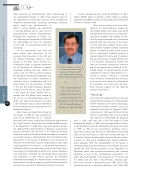
“On the international front close ties were forged with researchers at the Louisiana State University in the USA and the National Veterinary Institute in Oslo, Norway.”
Other success stories include the deve- lopment of a new method to prepare an anti-oxidant extract from grape seed which was patented and licensed to a major phar- maceutical company, the isolation of seve- ral anti-fungal compounds with commercial potential and the screening of the leaves of more than 500 southern African trees, some of which had been used by traditional healers. The practical nature of this research and its commercial potential ensured a constant stream of funding and of students, and also the services of Lyndy McGaw who is his second-in command at present. His work also attracted international attention and he was appointed as leader of an EU- funded project to develop quality control standards for African Herbal Medicines ex- ported to Europe, reflecting a renewed global interest in ethnoveterinary medicine. Local interest in his research is reflected by its recognition as a ‘niche area’ for long- term financial support by the National Research Foundation.
Physiology
One of the first six appointments to the new Faculty of Veterinary Science in 1920 was that of W.H. Andrews to the chair in physiology. Unfortunately health problems led to his resignation and return to England in 1924. His successor in 1925 was F.W. Steck, former lecturer in pathology, who in turn resigned and returned to Switzerland the following
PART 2
Faculty of Veterinary Science: General History
1908-2008
Years


