


Page 17 - VHSA - Onderstepoort 100 Years - Part 2
P. 17
in postgraduate studies. In 1988 a new research strategy was developed with the identification of three research themes i.e. babesiosis in dogs, heartwater in cattle and colic in horses.
The clinical pathology laboratory run by F. Reyers showed dynamic growth and collaboration with other instances, both national and international, increased drama- tically. On par with the rest of the Faculty teaching methods also changed to a more problem-based student-oriented approach and improved exposure of students to clinical cases. Seven different species-based clinics, both static and mobile, were developed where students could gain experience on a rotation basis and provide a service to the community at the same time. The move in 1996 to the new hospital with its world-class facilities further enhanced these activities.
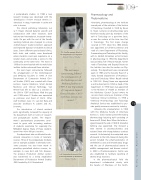
The next major restructuring followed the amalgamation of the Onderstepoort and Medunsa faculties in 1999. A new Department of Companion Animal Clini- cal Studies (CACS) was created with three sections: Equine Medicine, Small Animal Medicine and Clinical Pathology. Van Amstel had left to take up a position in the USA in 1997 and Reyers filled the gap until 1999 when P. Stadler was appointed as professor and head of CACS. Other staff members were J.S. van den Berg and associate professors R. Lobetti and A.L. Leisewitz.
The introduction of clinical assistant posts significantly increased the capacity of the department both in terms of research and postgraduate studies. The depart- ment’s postgraduate programme conti- nued to grow with increasing numbers of students registering for especially the MMedVet degree. Many of these students came from other African countries.
The department also contributed to edu- cational innovation in terms of telematic courses. Three of its postgraduate modules are for example available in telematic form. Some progress has also been made in providing specialized elective courses, for example in cage bird and fish diseases. The previous Production Animal section was transferred to a newly established Department of Production Animal Studies (PAS) headed by G.H. Rautenbach.
“The next major restructuring followed the amalgamation of the Onderstepoort and Medunsa faculties in 1999. A new Department of Companion Animal Clinical Studies (CACS) with three sections was created...”
ONDERSTEPOORT 100
Pharmacology and
Phytomedicine
Historically, pharmacology at the Institute formed part of the activities of the Section
of Toxicology, founded in 1928 by Douw
G. Steyn. Lectures on pharmacology were therefore mostly given by members of the
staff of Toxicology on a part-time basis,
as was the custom at the time (see Part
3: Toxicology). The first major change occurred in 1971 when W.L. (Bill) Jenkins
was appointed as full-time professor and
head of a new Department of Physiology, Pharmacology and Toxicology at the Faculty,
with A. (André) Immelman as first lecturer
in pharmacology. In 1984 the department
was joined by T.W. (Theuns) Naudé, former
head of Toxicology and Deputy-Director at
the Institute (see also the section on Phy- siology). The department was reorganized
again in 1986 and he became Head of a
newly formed Department of Pharmaco-
logy and Toxicology. When Naudé retired
in 1992 G.E. (Gerry) Swan was appointed
as acting head and in 1994 as head of the department. In 1996 Swan was appointed
by the Minister of Health as member of
the Medicines Control Council where he
has since been serving as chairman of the Veterinary Clinical Committee. In 1998 a Veterinary Pharmacology and Toxicology Analytical Service was established to pro- 77 vide quality assurance services to industry.
Following the amalgamation in 1999 with the Medunsa Faculty of Veterinary Science, C. (Colin) Catton joined the existing pharmacology lecturing staff consisting of Swan and P. (Peter) Buss. When the latter re- signed towards the end of 1999 R. (Ronette) Gehring was appointed. She showed a keen interest in pharmacokinetics and assisted Swan with bioequivalence contract research. Unfortunately she emigrated soon afterwards to the USA. Research during this period included the pharmacokinetics of anthelmintics and anti-inflammatory drugs and the use of pharmaceutical agents in wildlife management and disease control. In 2000 a Pharmacovigilance Centre was also established to facilitate reporting of
adverse drug reactions.
In the pharmacological field the
department collaborated closely with the Faculty of Pharmacy of the North-
Faculty-specific Departments
1908-2008
Years


